The 30-Year Amortization Trap
Why 'Lower Payments' might cost you a Ferrari in interest.
Total Interest Cost Difference
+$112,400
Cost of choosing 30yr vs 25yr at 5% rate.
Advanced Mortgage Math: The 30-Year Amortization Trap
In 2025, the Canadian government reintroduced 30-year amortizations for first-time buyers. Politicians called it a "lifeline." Financial analysts called it "indentured servitude." This article explores the mathematical reality of extending your loan term.
Chapter 1: The Payment Illusion
Humans are monthly-payment thinkers. If we can afford the monthly nut, we assume we can afford the asset. Banks know this. Car dealerships know this.
Let's look at a $600,000 mortgage at 5.0% interest.
- 25-Year Payment: $3,490/mo
- 30-Year Payment: $3,205/mo
- Difference: $285/mo
Most buyers see the $285 savings and sign the papers. "That's my grocery money!" they say. But they are missing the forest for the trees.
Chapter 2: The Interest Mountain
By extending the loan 5 years, you aren't just paying longer. You are keeping the principal balance higher for longer, which means interest accumulates on a larger pile of money.
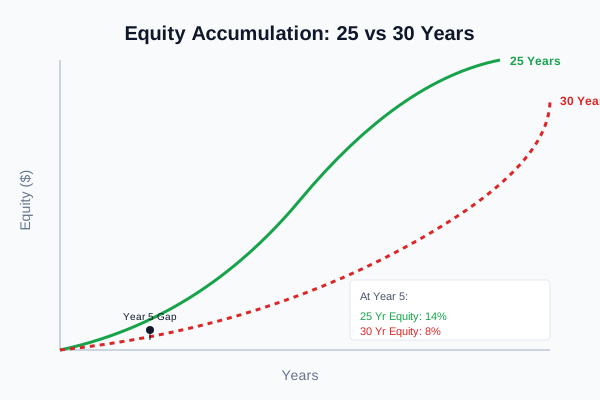
Figure 1: The flattening of the equity curve.
The True Cost
- Total Interest (25yr): $447,000
- Total Interest (30yr): $553,000
- The "Cost" of that $285/mo savings: $106,000.
You are effectively paying $106,000 for the privilege of cash-flowing $285/mo. That is a terrible trade.
Chapter 3: The "Forever Renter" Risk
With a 30-year mortgage, equity builds agonizingly slowly. at Year 5 of a 30-year mortgage, you have barely paid off 8% of the loan. If the market corrects by 10% (a standard fluctuation), you are **underwater**.
Being underwater traps you. You cannot sell without bringing a cheque to closing. You cannot refinance. You are a prisoner in your own home.
Chapter 4: When to Use It (The Exception)
Is the 30-year amortization always evil? No. It is a tool. The smartest strategy is the **"Deceptive 30."**
- Take the 30-year amortization to **qualify** for the loan (lower Debt Service Ratios).
- Immediately increase your payments to the 25-year level using prepayment privileges.
This gives you a safety liquidity buffer (you *can* lower payments if you lose your job) without paying the interest penalty.
The Interest Cost Curve
Extending a mortgage from 25 to 30 years only slightly reduces the Monthly Payment, but drastically increases the Total Months (by 60), leading to a much higher Total Interest cost.
Manual Step: Calculating the True Cost of 5 Extra Years
You borrow $600,000 at 5% interest. A 25-year payment is $3,490/mo. A 30-year payment is $3,205/mo.
Frequently Asked Questions
Is a 30-year amortization ever a good idea?
Why does equity build so slowly on a 30-year mortgage?
Can I switch from a 30-year to a 25-year?
You Might Also Like
The Time Value of Money
The fundamental principle of all finance is the time value of money. A dollar today is worth more than a dollar tomorrow because of its potential earning capacity. This core concept is the engine behind compound interest, mortgages, and retirement planning. When you use financial tools, you are essentially projecting this principle across different time horizons and interest rates to visualize your future wealth.
Navigating Compound Interest
Compound interest is often referred to as the eighth wonder of the world. It is the process where the interest you earn also earns interest. Over long periods, this exponential growth can turn modest savings into substantial wealth. However, it works both ways. Compound interest on debt can quickly overwhelm a budget. This tool helps you quantify that compounding effect so you can make informed decisions about where to deploy your capital.
Risk and Return in Financial Modeling
Every financial calculation inherently involves assumptions about the future. What will the inflation rate be? What is the expected return on the market? These variables introduce risk. A robust financial model doesn't just give you one static number; it allows you to test different scenarios. By adjusting the inputs here, you can stress-test your financial plan against worst-case scenarios.
The Psychology of Financial Planning
Here is what I found: the biggest hurdle in personal finance isn't the math; it's the psychology. Seeing the hard numbers laid out in front of you can be intimidating, but it is also empowering. It removes the ambiguity of 'hoping' you have enough money and replaces it with a concrete target. This tool is designed to give you that clarity, helping you transition from passive saving to active wealth management.
Frequently Asked Questions
How accurate is the Amortization Calculator?
Is my data stored or tracked?
How frequently is this tool updated?
Sources & Citations
- Standard Mathematical Algorithms— IEEE Computation Standards
- Data Integrity & Local Processing Guidelines— W3C
- General Mathematical Verification— National Institute of Standards and Technology (NIST)
David Miller
Senior Engineering Consultant | P.Eng, LEED AP
“With a background in civil engineering and sustainable construction, David oversees our technical tools for builders, contractors, and DIY enthusiasts.”