BRRRR Calculator
The ultimate tool for scaling your real estate portfolio. Analyze your Buy, Rehab, Rent, Refinance, and Repeat strategy math.
The BRRRR Strategy Cycle
The BRRRR method lets you "recycle" capital to build a real estate portfolio faster than traditional buy-and-hold.
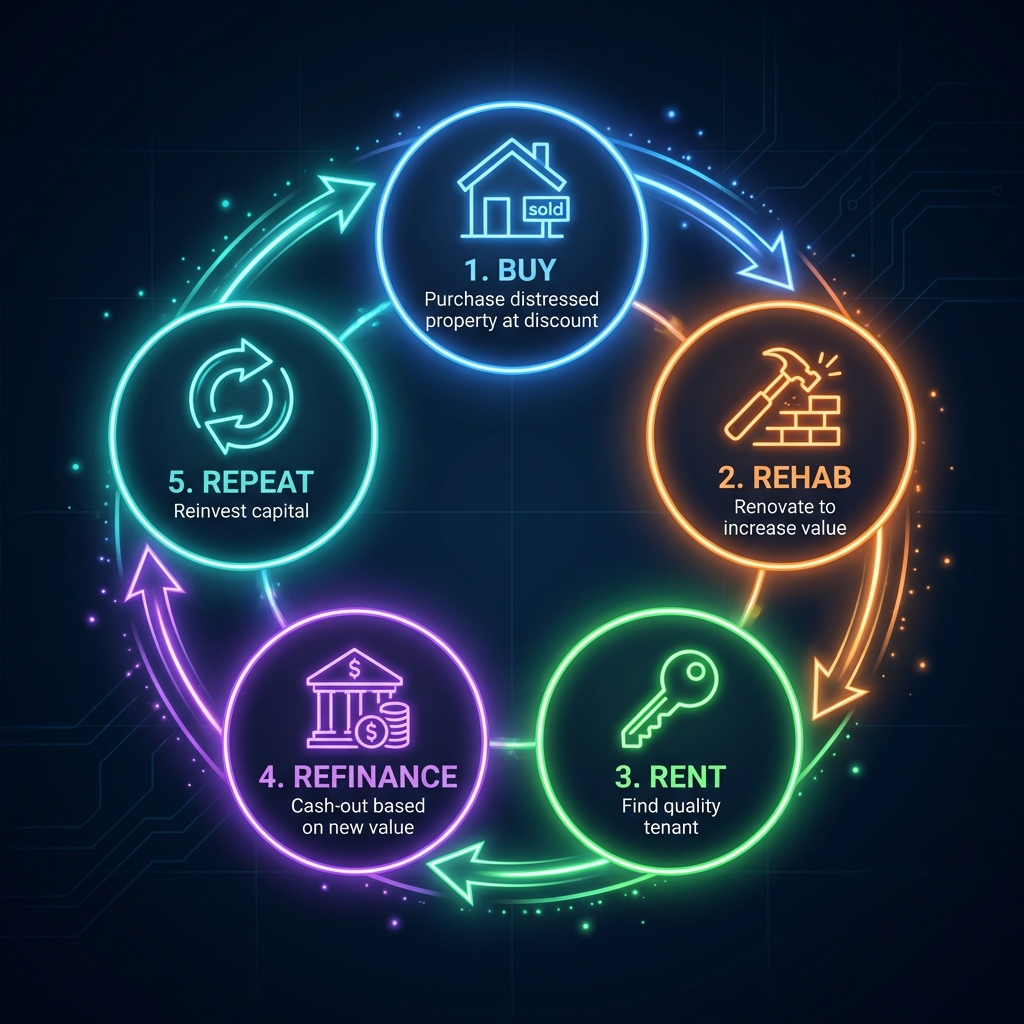
The Five Phases of BRRRR
1. Buy
Purchase distressed property at 75% or less of After Repair Value (ARV).
2. Rehab
Renovate to manufacture equity. Focus on kitchens, baths, and curb appeal.
3. Rent
Secure a quality tenant to prove income before refinancing.
4. Refinance
Cash-out refinance at 75% LTV based on new appraised value.
5. Repeat
Reinvest your recovered capital into the next deal.
Key Metrics to Watch
| Metric | What It Measures | Target |
|---|---|---|
| Cash Left in Deal | Money still tied up after refinance | $0 or negative (infinite return) |
| ROE (Return on Equity) | How hard your equity works for you | Higher is better |
| DSCR | Rent coverage of new mortgage payment | 1.2x or higher |
| Total Investment | Purchase + Rehab + Closing + Holding | ≤ 75% of ARV |
BRRRR vs Traditional Buy-and-Hold
| Factor | BRRRR Strategy | Traditional |
|---|---|---|
| Capital Required per Property | Low (recycles) | High (20% down each time) |
| Time to Scale | Fast (1-3 years for 10+ units) | Slow (years of saving) |
| Complexity | High (rehab + refinance) | Low (buy and hold) |
| Risk Level | Higher (rehab overruns, ARV miss) | Lower |
Why Use This Calculator?
BRRRR deals have many moving parts: holding costs, two sets of closing costs, rehab overages, and varying LTV limits. One mistake in your math early on can mean having $50,000 "trapped" in a deal when you expected $0. This tool helps you simulate the Refinance Reality before you even submit an offer on the purchase.
July 2026 Refinance Stress Check
A BRRRR deal only works if the refinance clears after the rehab, not just on the day you buy. Before you submit an offer, rerun the model with a lower appraisal, a higher permanent mortgage rate, and a larger contingency reserve.
| Stress Test | Why It Matters | Action |
|---|---|---|
| ARV haircut | A lower appraisal reduces the cash-out loan ceiling. | Test 5%, 10%, and 15% below your optimistic ARV. |
| Rate shock | Higher permanent debt can erase the rent spread. | Compare the refinance payment with the mortgage calculator. |
| Exit delay | Seasoning rules and inspections can extend holding costs. | Add two extra months of taxes, insurance, utilities, and debt service. |
If the deal only survives under perfect assumptions, compare the same capital against the ROI calculator before committing cash to the rehab.
BRRRR Target Equity Formula
To achieve a perfect BRRRR (infinite return), your total all-in cost must be less than or equal to the maximum loan amount your lender will provide on the After Repair Value (ARV).
Manual Step: The Infinite Return Math
You find a distressed home with an After Repair Value (ARV) of $200,000. It needs $30,000 in rehab. Closing/holding costs will be $5,000. The lender allows 75% LTV on the refinance.
Frequently Asked Questions
What does BRRRR stand for?
What is an 'Infinite' BRRRR?
What is the 70% rule in BRRRR?
How long do I have to wait to refinance?
What are the biggest risks of the BRRRR strategy?
You Might Also Like
The Time Value of Money
The fundamental principle of all finance is the time value of money. A dollar today is worth more than a dollar tomorrow because of its potential earning capacity. This core concept is the engine behind compound interest, mortgages, and retirement planning. When you use financial tools, you are essentially projecting this principle across different time horizons and interest rates to visualize your future wealth.
Navigating Compound Interest
Compound interest is often referred to as the eighth wonder of the world. It is the process where the interest you earn also earns interest. Over long periods, this exponential growth can turn modest savings into substantial wealth. However, it works both ways. Compound interest on debt can quickly overwhelm a budget. This tool helps you quantify that compounding effect so you can make informed decisions about where to deploy your capital.
Risk and Return in Financial Modeling
Every financial calculation inherently involves assumptions about the future. What will the inflation rate be? What is the expected return on the market? These variables introduce risk. A robust financial model doesn't just give you one static number; it allows you to test different scenarios. By adjusting the inputs here, you can stress-test your financial plan against worst-case scenarios.
The Psychology of Financial Planning
Here is what I found: the biggest hurdle in personal finance isn't the math; it's the psychology. Seeing the hard numbers laid out in front of you can be intimidating, but it is also empowering. It removes the ambiguity of 'hoping' you have enough money and replaces it with a concrete target. This tool is designed to give you that clarity, helping you transition from passive saving to active wealth management.
Frequently Asked Questions
How accurate is the BRRRR Strategy Calculator?
Is my data stored or tracked?
How frequently is this tool updated?
Sources & Citations
- Standard Mathematical Algorithms - IEEE Computation Standards
- Data Integrity & Local Processing Guidelines - W3C
- General Mathematical Verification - National Institute of Standards and Technology (NIST)
Finance Editorial Desk
Financial Calculator Research | Formula review, Public-source data checks
“The finance desk maintains mortgage, tax, retirement, loan, and investment calculators using documented formulas, public agency references, and repeatable test cases. These tools provide educational estimates, not personalized financial advice.”
Deep Dive: Understanding the BRRRR Strategy Calculator
Analyze the Buy, Rehab, Rent, Refinance, Repeat real estate investment strategy. Here is how it works and why this specific computation is critical for your larger goals.
The Time Value of Money
The fundamental principle of all finance is the time value of money. A dollar today is worth more than a dollar tomorrow because of its potential earning capacity. This core concept is the engine behind compound interest, mortgages, and retirement planning. When you use financial tools, you are essentially projecting this principle across different time horizons and interest rates to visualize your future wealth.
Navigating Compound Interest
Compound interest is often referred to as the eighth wonder of the world. It is the process where the interest you earn also earns interest. Over long periods, this exponential growth can turn modest savings into substantial wealth. However, it works both ways. Compound interest on debt can quickly overwhelm a budget. This tool helps you quantify that compounding effect so you can make informed decisions about where to deploy your capital.
Risk and Return in Financial Modeling
Every financial calculation inherently involves assumptions about the future. What will the inflation rate be? What is the expected return on the market? These variables introduce risk. A robust financial model doesn't just give you one static number; it allows you to test different scenarios. By adjusting the inputs here, you can stress-test your financial plan against worst-case scenarios.
The Psychology of Financial Planning
Here is what I found: the biggest hurdle in personal finance isn't the math; it's the psychology. Seeing the hard numbers laid out in front of you can be intimidating, but it is also empowering. It removes the ambiguity of 'hoping' you have enough money and replaces it with a concrete target. This tool is designed to give you that clarity, helping you transition from passive saving to active wealth management.
Method and Limitations
This tool applies the formula and assumptions shown on the page to the values you enter. Rounding, changing rates, local rules, and incomplete inputs can all affect the result. Use the output as an educational estimate and verify important financial, health, tax, legal, or engineering decisions with an appropriate qualified professional.
More Finance Calculators
Expert-level 2026 Canadian income tax modeling. Calculate Federal and Provincial liabilities with updated $16,452 BPA, CPP2/YAMPE deductions, and RRSP/FHSA tax-shield arbitrage.
Forensic-grade geometric growth modeling for the 2026-2036 housing cycle. Model regional multipliers and scarcity nodes for Toronto, Vancouver, and the Prairie nodes.
Calculate your total 2026 CPP contributions across both Tier 1 and Tier 2 (Enhanced) ceilings. Master the YAMPE math for high-earner payroll deductions.